

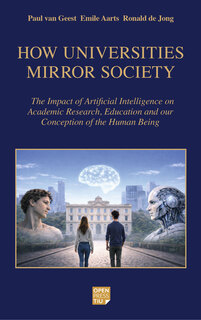
How Universities Mirror Society

The Impact of Artificial Intelligence on Academic Research, Education and our Conception of the Human Being

by Paul van GeestEmile AartsRonald de Jong

What will happen to the university when knowledge is no longer scarce, but ubiquitously available and even produced by machines? In The University as a Mirror of Society, Paul van Geest, Emile Aarts, and Ronald de Jong show how artificial intelligence reaches into the very heart of academia, thus impacting education, research, governance, and our understanding of what it means to be human.

This book is a journey taking the reader from the medieval university to the contemporary campus, demonstrating how universities have continuously been challenged to respond to major societal shifts. However, the current AI revolution is different. AI is not merely a tool; it is transforming the very conditions under which knowledge is created, evaluated, and trusted. In doing so, it places the university’s traditional role as gatekeeper under increasing existential pressure.

The authors provide a clear analysis of AI as a system technology and discuss its implications for scientific integrity, the transformation of academia, and the future of work at large. At the same time, they pose a fundamental question: how will AI-technologies shape our conception of humankind and how does this inflict the university as a space for reflection and critical inquiry?

This book is a powerful plea for a university that strives not only to be faster and more efficient, but above all wiser, more careful, and more humane.

Recent Activity

  • Text Added

    How Universities Mirror Society

  • Project Kickoff

    A Manifold at the Open Press Tilburg University project is born!

“The rise of artificial intelligence confronts leaders not only with technological challenges, but above all with moral questions. This book demonstrates that the university is pre-eminently the place where knowledge, values, and responsibility must remain interconnected. It constitutes a powerful plea for a values-driven approach to science and society, in which our conception of humanity and moral compass should be decisive for academic leaders.”

Prof. Dr Jan Peter Balkenende, Minister of State, former Prime Minister, and Emeritus Professor of Governance, Institutions and Internationalisation at Erasmus University Rotterdam.

“The authors have succeeded in presenting a clear and compelling account of the ways in which artificial intelligence is set to influence the academic world in relation to society and our conception of humankind.”

Prof. Dr Kim Putters, President of the Dutch Social and Economic Council (SER) and University Professor of Broad Prosperity at Tilburg University

About the authors

Paul van Geest (1964)

is a Dutch language and literature scholar and theologian (Leiden, Gregoriana). Since 2001, he has been Endowed Professor of Augustinian Studies at the Catholic Theological University Utrecht and at VU Amsterdam. Since 2007, he has been Full Professor of Church History and the History of Theology at Tilburg University, and since 2018, Full Professor of Theology and Economics at Erasmus University Rotterdam as well. In 2026, he was appointed Distinguished Professor at Tilburg University. His scholarly work comprises hundreds of publications and more than 30 books in the fields of medieval theology, the interaction between theology and economics, and the thought of Augustine.

Emile Aarts (1955)

was educated as a mathematician and physicist in Nijmegen and Groningen. From 1982 to 2012, he worked at Philips Research in various positions, the last of which was Chief Scientific Officer. From 2012 to 2015, he was Dean of the Faculty of Mathematics and Computer Science at Eindhoven University of Technology. From 2015 to 2019, he was Rector Magnificus of Tilburg University. His scholarly work comprises more than 200 publications and more than 20 books in various fields including artificial intelligence. He currently works as a commissioner, advisor, and board member.

Ronald de Jong (1967)

studied Business Administration at Erasmus University Rotterdam. He has been Professor of Practice in Business at Tilburg University since 2017. He was a member of the Executive Committee and Executive Vice President of Royal Philips (2011–2019), as well as founder and chairman of the Philips Foundation. In addition, he held advisory and supervisory positions at, among others, the Erasmus Center for Leadership, SNV, TNO and the Advisory Council on International Affairs

Metadata